
Introduction: Why Most Business Ecosystems Fail
"Let's build an ecosystem."
It sounds strategic. It sounds modern. It sounds like growth.
But in reality, most B2B ecosystems fail — not because the idea is wrong, but because the starting point is.
Most companies begin with:
- partnerships
- events
- community building
And they expect results.
But what they get instead:
- low engagement
- no consistent leads
- no real business impact
At the same time, B2B buying behavior has fundamentally changed.
According to McKinsey & Company, only around 31% of B2B purchases are now handled through direct sales channels, compared to 57% just a few years ago.
Buyers are no longer waiting to be contacted.
They are actively searching, comparing, and learning across multiple channels. Gartner reports that B2B buyers now spend only 17% of their total purchase journey meeting with potential suppliers — and when comparing several vendors, that time per supplier drops to just 5%. Forrester similarly notes that the majority of buying decisions are made before sales is ever contacted.
This creates a new reality:
If you are not visible when the demand exists, you are not part of the buying process.
And this is exactly where most ecosystems fail. They try to build relationships before they build demand.
What Is a Business Ecosystem (In Practice)?
A business ecosystem is often described as a network of companies working together. That's partially true — but incomplete.
A real B2B ecosystem consists of:
- companies (you + partners)
- customers and prospects
- content and knowledge
- distribution channels
- visibility across search and platforms
But the key is this:
A business ecosystem is a system that continuously generates demand and distributes it across participants.
Without demand, it's just a network. With demand, it becomes a growth engine.
Why Traditional Lead Generation Is Reaching Its Limits
Many companies still rely heavily on:
- outbound sales
- paid campaigns
- content without clear intent
But the effectiveness is declining.
Key trends shaping B2B in 2025:
- Cost per lead has increased significantly (in some sectors +40%+)
- Conversion rates are slowly declining
- Buyers trust third-party sources more than direct brand messaging
- Buying decisions involve an average of 8+ stakeholders
This leads to three major challenges:
1. Information Overload
Your potential customers see thousands of messages daily.
2. Trust Gap
Decision-makers rely more on ecosystems, peers, and external validation.
3. Fragmented Buying Journey
Buyers interact with multiple sources before making a decision.
This is exactly why ecosystems are becoming critical.
The Role of Partner Ecosystems in Modern B2B Growth
Data shows a clear shift:
- Companies generating a significant share of revenue through partners grow faster
- Partner-generated leads tend to convert better
- Customer acquisition costs decrease when ecosystems are active
The reason is simple. Partners bring:
- trust
- distribution
- access to existing relationships
But here's the mistake many companies make: they try to build partner ecosystems without demand.
The Key Insight: Demand Comes First, Partners Follow
Most companies think:
"Let's find partners, then we'll grow together."
In reality:
The most successful ecosystems are built on existing demand.
When you already have visibility, inbound interest and leads, partners become naturally interested.
They don't join an idea. They join momentum.
Real Examples: Ecosystems That Actually Generated Demand
Sitedrive – Lean Construction Community
Sitedrive focused on a very specific niche: lean construction professionals.
Instead of pushing the product directly, the focus was on:
- useful content
- practical insights
- community value
Result: around 100 engaged members per month and steady growth without aggressive sales.
The key lesson: Value-driven visibility builds trust faster than direct selling.
Viima – Innovation Management Ecosystem
Viima focused heavily on content and education around innovation management. Particularly strong traction came from South America.
Results included:
- over 3,500 monthly readers
- more than 50 SaaS signups per month
- peak days with up to 80 signups
The key insight: When content truly solves problems, it scales globally.
The Core Model Behind Successful Ecosystems
A working ecosystem follows a simple but powerful logic:
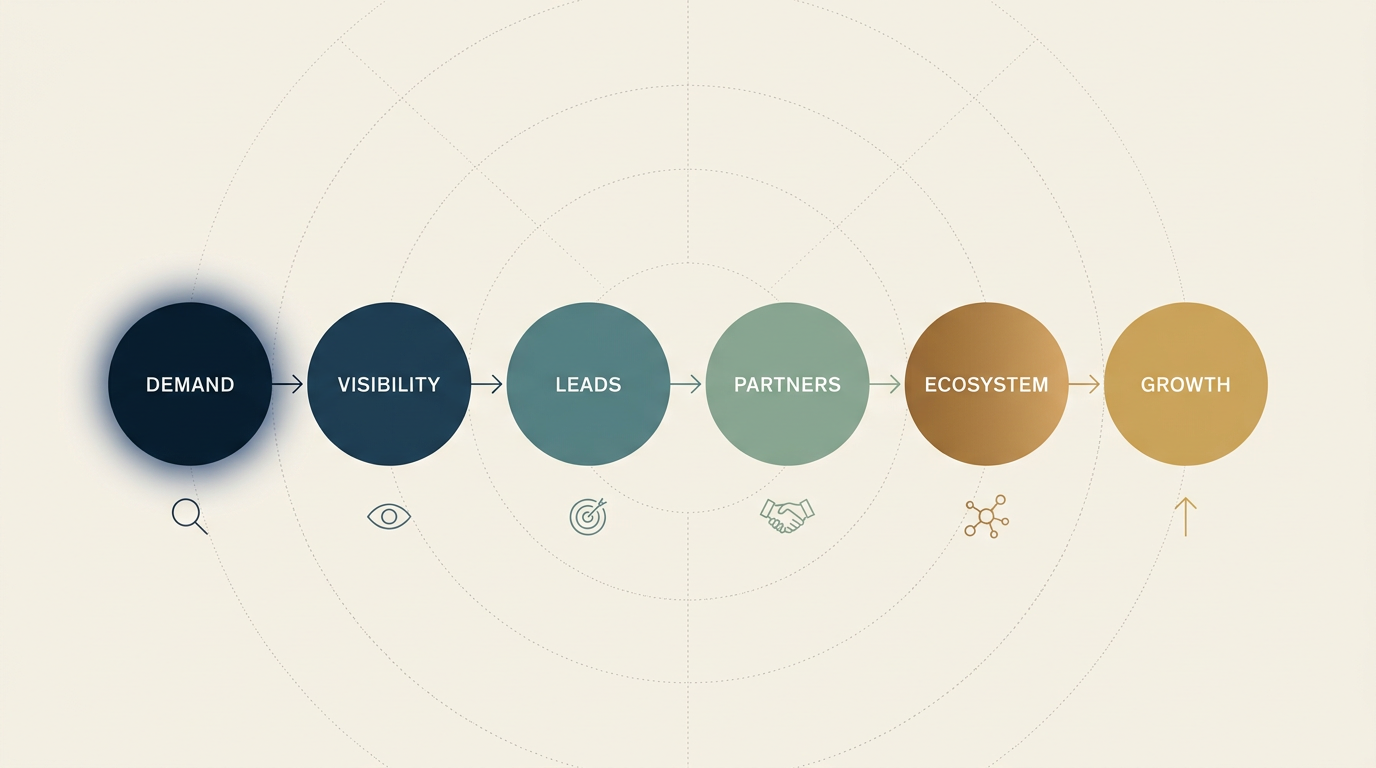
Demand → Visibility → Leads → Partners → Ecosystem → Growth
Each stage builds on the previous one. Skipping steps usually leads to failure.
Traditional vs Demand-Driven Ecosystem
Here is how the two approaches compare in practice:
| Dimension | Traditional Ecosystem | Demand-Driven Ecosystem |
|---|---|---|
| Starting point | Partnerships and events | Market demand and search intent |
| Primary activity | Networking and outbound | SEO, GEO and content visibility |
| Lead source | Cold outreach, paid ads | Inbound from search and AI engines |
| Partner motivation | Hope of mutual benefit | Access to existing demand and leads |
| Time to traction | 12–24 months, often unclear | 3–6 months to validate, 6–12 to scale |
| Cost per lead trend | Rising (+40% in many sectors) | Declining as organic visibility compounds |
| Defensibility | Low — partners can leave | High — owned demand and search assets |
Step-by-Step: How to Build a Demand-Driven Ecosystem
Step 1: Start with Demand (SEO + GEO)
Before choosing markets or partners, you need to understand demand. This is done through:
- keyword research
- search intent analysis
- country-specific demand mapping
SEO helps you capture demand in Google. GEO (Generative Engine Optimization) helps you capture visibility in AI-driven environments like ChatGPT and other AI tools.
Together, they form the foundation of modern inbound visibility. If you want to validate demand before investing in content, start with a free market demand analysis to map keyword volume, intent and competitor visibility in your target market.
Step 2: Define a Narrow B2B Niche
Broad targeting leads to weak results. Strong ecosystems are built around:
- very specific audiences
- clear problems
- defined use cases
For example: not "manufacturing companies" — but "predictive maintenance decision-makers in manufacturing."
The more specific the niche, the easier it is to dominate visibility.
Step 3: Build Multi-Channel Visibility
Once the niche is clear, visibility must be built across channels:
- SEO + GEO content
- Google Ads targeting high-intent searches
- LinkedIn or Meta for niche targeting
- Event-based visibility around industry moments
This creates multiple entry points into your ecosystem.
For a deeper look at how to systematically manufacture inbound demand, see our guide on B2B demand generation.
Step 4: Capture and Convert Demand
Visibility alone is not enough. You need:
- optimized landing pages
- clear value propositions
- simple conversion paths
At this stage, you start generating leads, conversations and early customers. This is critical — because now you have proof.
Step 5: Introduce Partners Into Real Demand
This is where most strategies fail — or succeed.
Instead of asking partners to join early, you bring them into:
- real leads
- real opportunities
- real visibility
This changes the dynamic completely. Partners are no longer "recruited." They are attracted.
Step 6: Build the Ecosystem Around Value
Once demand and partners are aligned:
- content becomes collaborative
- visibility expands
- trust increases
At this point, the ecosystem becomes self-reinforcing.
Types of Partners in a B2B Ecosystem
Not all partners contribute in the same way. Common partner types include:
- Referral partners — high conversion rates
- Implementation partners — strong lead identification
- Technology partners — market expansion
- Resellers — volume-driven growth
The key is not the number of partners, but their activity, alignment and ability to generate or convert demand.
If your company sells SaaS or technology, the same model applies — explored in detail in our international B2B sales system framework.
Common Mistakes in Ecosystem Building
Even well-designed strategies can fail due to common mistakes:
- starting with branding instead of demand
- focusing on traffic instead of intent
- building partnerships without clear value
- expecting immediate results
- lacking consistent execution
Ecosystems require time. Typical timelines:
- 3–6 months: early signals
- 6–12 months: consistent lead flow
- 12–18 months: scalable ecosystem
The Role of AI and GEO in Ecosystem Growth
AI is changing how ecosystems are built and scaled. New opportunities include:
- visibility in AI-driven search
- better targeting of niche audiences
- improved content distribution
GEO ensures that your content is visible not only in search engines, but also in AI tools where buyers increasingly ask questions and explore solutions.
However, the core principle remains unchanged:
Technology amplifies demand — it does not create it.
Internal Resources (Recommended Reading)
To go deeper into related topics, you can explore:
- Fractional CRO: What It Is, Benefits, Cost and When to Hire One
- B2B Demand Generation System
- International B2B Sales System
These topics connect directly to ecosystem building and demand generation.
Frequently Asked Questions
What is a business ecosystem in B2B?
A business ecosystem in B2B is a network of companies, partners, content, and channels that together generate and distribute demand. The most effective ecosystems are built around real market demand, not just partnerships.
How long does it take to build a successful ecosystem?
Typically: 3–6 months to validate demand, 6–12 months to generate consistent leads, and 12–18 months to scale into a full ecosystem.
Do you need partners to start building an ecosystem?
No. In fact, starting with partners is a common mistake. Successful ecosystems start with demand, visibility and inbound leads. Partners are introduced after traction exists.
What is the difference between SEO and GEO?
SEO focuses on visibility in search engines like Google. GEO (Generative Engine Optimization) focuses on visibility in AI-driven tools, where users ask questions and explore solutions. Both are essential in modern B2B marketing.
Can small companies build ecosystems?
Yes. Company size is less important than product-market fit, a clear niche and the ability to generate demand. Even small companies can build strong ecosystems if they focus on the right strategy.
Conclusion
A successful business ecosystem is not built through networking alone. It is built through:
- understanding demand
- creating visibility
- delivering consistent value
Everything else — partners, growth, scale — follows from that.
Let's Talk
I would love to help you create your true growth ecosystem — one built on real demand, not assumptions.
Reach out directly: hola@jannesivula.com