Generative Engine Optimization is attracting plenty of attention. Concrete evidence is harder to find. This article shows what GEO looks like in practice: a Finnish industrial manufacturer appearing in relevant ChatGPT and Gemini answers in Spanish, English and French.
The example comes from my work with MenSe Oy, a Finnish manufacturer of forestry-machine components that sells internationally. The content behind these results was built and optimized for search before ChatGPT existed.
Discovery now extends beyond a conventional Google results page. A buyer may encounter a company through Google Search, Google AI Overviews, ChatGPT, Gemini, Perplexity or Copilot. The commercial question remains the same: is your company visible when a buyer is researching something you sell?
Real evidence: three buying questions, three languages
The following tests were not generic prompts about forestry equipment. They were product and supplier questions close to a real buying situation.
1. A Spanish buyer asks where to buy Ponsse feed rollers
The question to ChatGPT was:
“¿De dónde comprar rodillos de alimentación para Ponsse?”
In English: “Where can I buy feed rollers for Ponsse?”
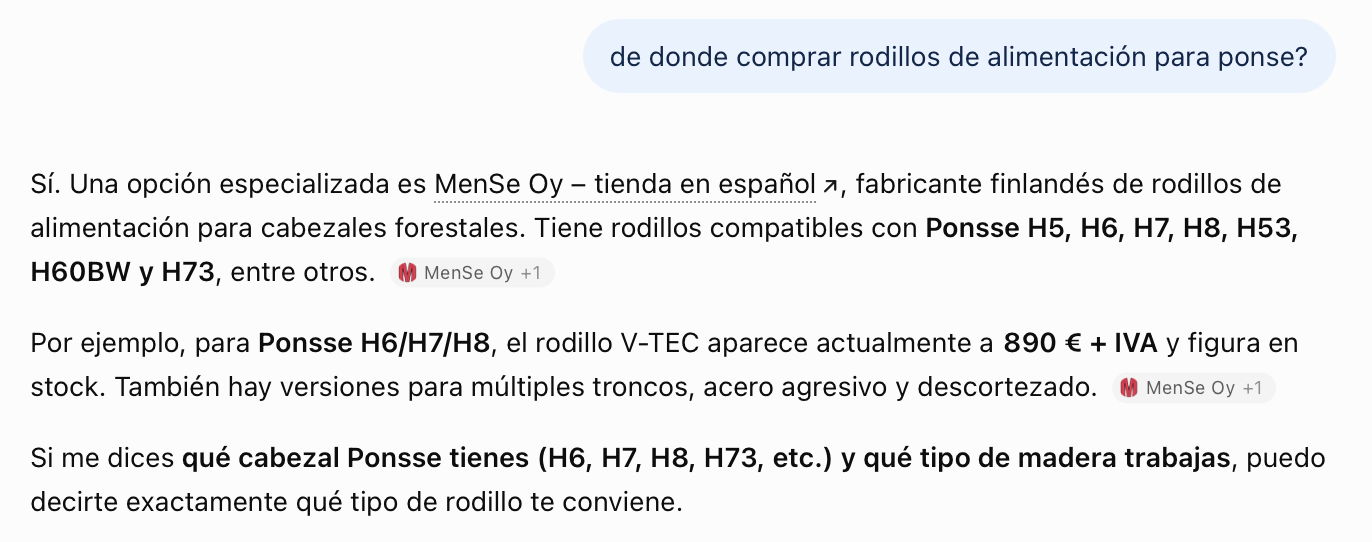
ChatGPT identifies MenSe as a Finnish manufacturer and recognizes compatibility with several Ponsse harvester heads. It also finds products, prices and alternatives.
This is close to commercial intent. The user did not ask what a feed roller is. The user asked where to buy one.
2. An English-language search from Vancouver
We then made the question more demanding by adding a buyer location and giving local suppliers a natural advantage:
“If you're in Vancouver / British Columbia and need feed rollers for a Ponsse harvester head, where to buy?”
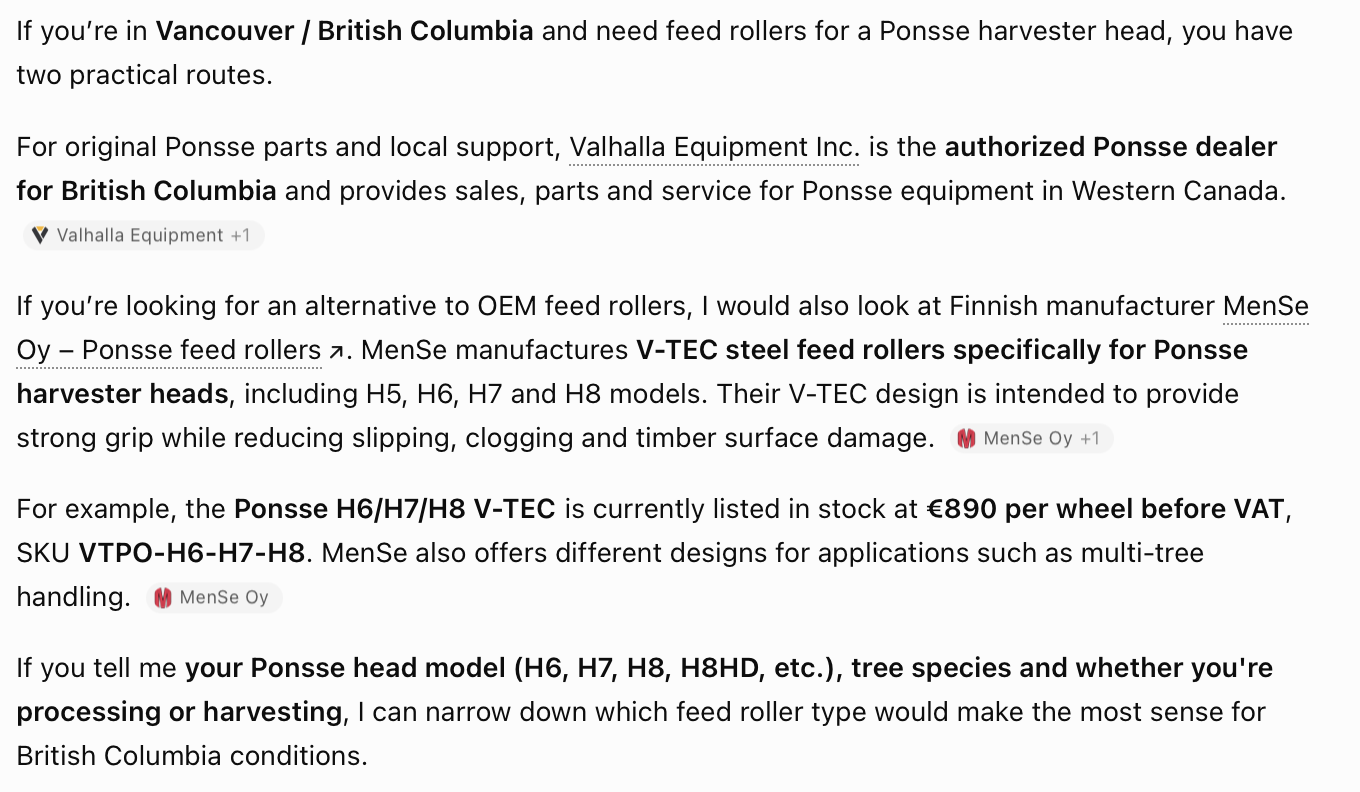
ChatGPT correctly understands that the buyer is in British Columbia and finds a local authorized dealer first. It then brings MenSe into the same answer and explains that the company manufactures V-TEC feed rollers for Ponsse harvester heads.
The detail that makes this more interesting is that MenSe uses a Finnish .fi website, not a .com domain. Clear product relevance can still travel across borders.
3. A French commercial query in Gemini
To test another language and another platform, I asked Google Gemini:
“Quel fabricant propose des rouleaux d'alimentation compatibles avec les têtes d'abattage Ponsse ?”
In English: “Which manufacturer offers feed rollers compatible with Ponsse harvester heads?”
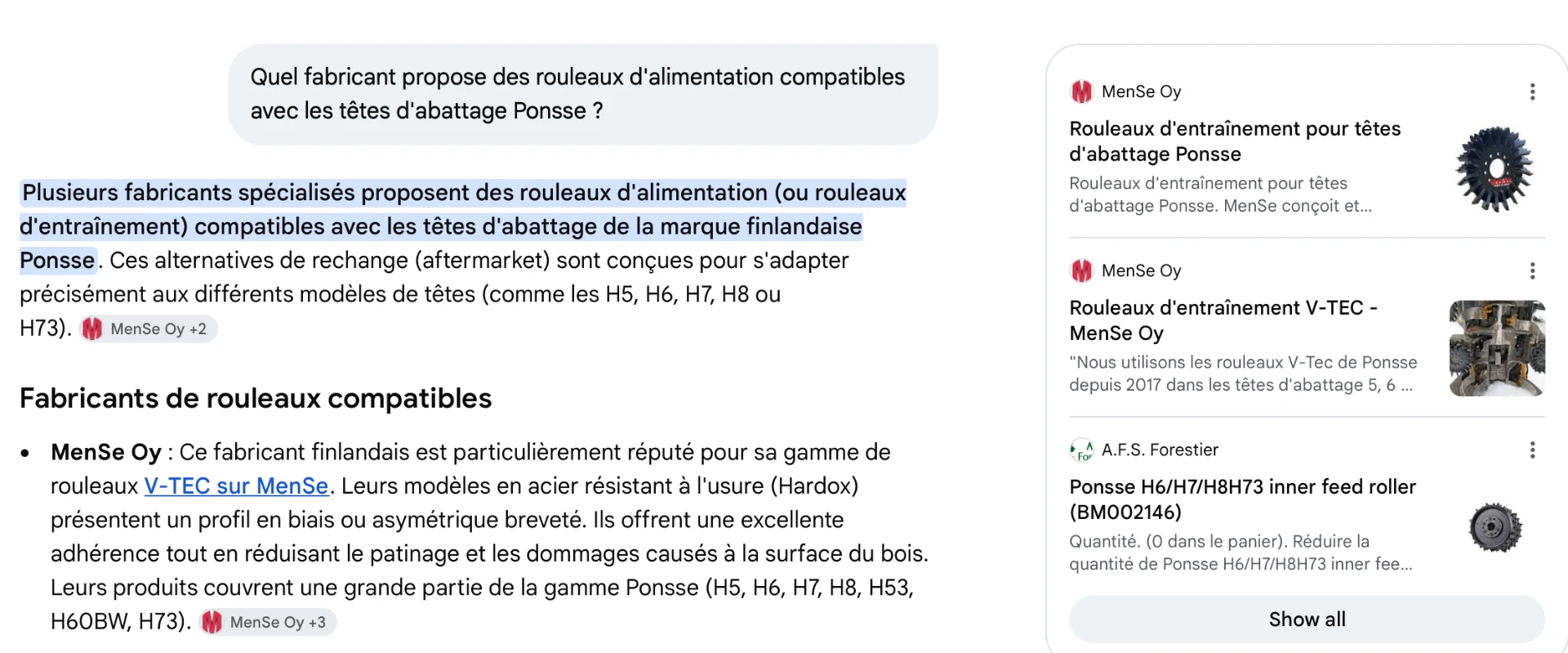
The evidence now covers three buying situations, three languages and two AI services, all pointing to the same Finnish manufacturer. It does not prove visibility for every prompt or platform. It does show that precise, established search content can make a specialist B2B company understandable and discoverable far beyond its home market.
A product made in Finland.
A potential buyer in Canada.
Another question asked in Spanish.
AI connects the buyer with the manufacturer.
GEO vs SEO: what is the difference?
SEO helps a page become discoverable and competitive in search results. GEO helps generative systems understand when that page, company or product is a useful source for an answer. The disciplines have different outputs, but they share much of the same foundation.
GEO does not replace SEO. In my experience, much of effective GEO is still rigorous SEO: understanding intent, maintaining a technically accessible website, using the right terminology, building topical depth and earning authority. The MenSe content in these examples was created for search engines before generative search became a category.
The practical difference is that a page must now do more than rank. Its meaning should be easy to extract: who the company is, what it provides, where it operates, what its products work with, which problem they solve, and why the source is credible.
For a deeper commercial framework, see B2B SEO consulting and the guide to AI visibility.
How Generative Engine Optimization works in practice
There is no single GEO switch to turn on. Adding the phrase “Generative Engine Optimization,” publishing a generic FAQ or creating an llms.txt file does not create authority on its own.
An AI system needs enough clear, corroborated context to connect a buyer's question with a relevant company. That usually requires five things.
1. Start with the buyer's real question
A definition may serve an early informational query. A commercial buyer needs more: compatibility, application, location, supplier evidence, options and the next step. Strong GEO content answers the full decision context rather than repeating a keyword.
2. Make products, applications and entities unambiguous
Use consistent names for the company, products, technologies, applications and compatible equipment. Explain relationships explicitly. For MenSe, details such as “V-TEC feed rollers” and “compatible with Ponsse harvester heads” give both people and machines precise context.
3. Structure content for quick understanding
Use descriptive headings, direct answers, short paragraphs and concrete lists. A useful pattern is simple: question, concise answer, evidence and conclusion. This helps a busy buyer and makes important passages easier for search and answer systems to interpret.
4. Support claims with evidence and trustworthy sources
First-hand examples, named expertise, technical specifications, customer evidence and credible citations distinguish useful content from generic summaries. Source quality matters because an answer engine needs reasons to trust and contextualize what it finds.
5. Localize for the market, not only the language
English, Finnish, Spanish and French buyers do not necessarily describe the same need in the same way. International GEO therefore starts with local demand and terminology, not word-for-word translation. This is also central to an effective international B2B sales system.
Why authority, citations and source quality matter
Generative systems assemble answers from context. A company becomes easier to understand when its own website describes its expertise consistently and independent sources reinforce the same entity, products and subject areas.
This does not mean manufacturing artificial mentions or adding unsupported claims. It means publishing accurate first-hand material, identifying the author and organization, citing dependable sources where they add value, and keeping technical and commercial facts consistent across the web.
In practical B2B content, authority often comes from specificity: a real product, a clear use case, accurate compatibility information, a named expert and evidence that can be checked.
How to measure AI search visibility
AI visibility should be measured, not guessed. No single metric captures the whole journey, and a citation is not automatically a lead.
- Track representative prompts. Test the commercial and informational questions buyers actually ask, across relevant languages and markets.
- Record citations and mentions. Note whether the company, product and source page appear, and whether the description is accurate.
- Monitor referral and conversion data. Use analytics and CRM evidence to identify visits, enquiries and opportunities attributed to AI services where that data is available.
- Compare visibility with business relevance. A mention for a high-intent product question matters more than broad exposure with no connection to what the company sells.
- Repeat the test. Outputs change, so use a consistent measurement set rather than treating one screenshot as permanent performance.
The three MenSe searches above are evidence of real visibility at the time of testing. They are not a claim that every user will receive the same answer, or that ChatGPT, Gemini, Perplexity and Copilot perform identically.
The practical conclusion: build SEO and GEO together
I have worked with SEO and international B2B growth for years. The rise of AI search does not make that foundation less important. It makes clear, specific and trustworthy content more valuable.
The objective is not maximum traffic or visibility for a fashionable acronym. It is qualified discovery: being present when a potential customer asks Google or an answer engine about a product, application or problem your company can genuinely solve.
That is also where a connected operating model helps. The Growth Engine brings search evidence, market signals, sales observations and measurement into the same learning cycle instead of treating GEO as an isolated content task.