How can a B2B marketing consultant help your sales team if they do not understand how your customers buy and how deals are closed?
That is the first question I would ask before hiring. You can have an immaculate website, well-presented campaigns and a monthly report full of charts. But if that work does not help you reach the right buyers and move sales conversations forward, something fundamental is missing.
Good B2B marketing consulting starts with understanding the business. What you sell, who buys it, why they choose you and what holds a purchase back. Only then does the consultant decide what to do and put it into practice.
These ten questions will help you distinguish a convincing proposal from a professional who can bring value to your company.
1. Do you have practical experience in B2B sales?
I do not mean selling their own marketing services. I mean taking part in business-to-business sales processes: speaking with buyers, preparing proposals, responding to objections and working with decisions that cannot be settled in a single call.
In an industrial sale, for example, the technical user may want your solution while procurement asks for another quote and management still needs to justify the investment. Marketing needs to help with those conversations.
What a convincing answer should include: examples of sales processes, who made the decision, what obstacles emerged and how they were addressed. Direct sales experience is a strong signal; the consultant must also demonstrate that they understand how your sales process works.
Warning sign: they talk about followers, reach and clicks but never ask how an enquiry becomes a customer.
2. Have you worked with companies whose business model resembles ours?
You do not need to find someone who has sold exactly the same component you manufacture. You do need someone who understands a similar level of commercial complexity.
Selling machinery, construction materials, defence solutions and B2B software involves particular challenges. Technical knowledge, perceived risk, timelines and the people involved in the decision all matter. A consumer campaign alone does not demonstrate that someone can work in that environment.
What to ask for: two or three comparable projects and an explanation of which experience would be useful to your company. Were sales direct, through distributors or through specifiers and other people influencing the purchase? Was the buying process long?
Warning sign: a list of sectors and logos without explaining what they did in each project.
3. What results can you demonstrate in the area we want to improve?
The reference should match the objective. If you want brand positioning, ask for brand work. If you need visibility in Google or in artificial intelligence answers, ask for evidence of that visibility. If you need sales opportunities, ask about the quality of enquiries and how they progressed through sales.
A useful result comes with context: the starting point, period, work carried out and investment. It also makes clear what the consultant contributed and what the client's team contributed.
What to ask for: concrete examples covering those conditions. An increase in traffic may be interesting, but you need to know whether it brought potential buyers or visitors with no connection to your offer.
Warning sign: impressive percentages without dates, a starting point or an explanation. Be wary, too, of anyone who attributes every sale to marketing without being able to justify it.
4. Can you show us how potential customers find us today?
Before hiring, I would ask for a small demonstration of judgement: what appears when a buyer searches for a solution like ours, who occupies that space and what obvious problems exist in our digital presence.
If your company exports, searching for its name in your home market is not enough. You need to see how buyers find it in the relevant markets and languages.
This is not about demanding a complete audit for free. A serious analysis takes time. But a few concrete initial observations help establish whether the proposal is based on your actual situation.
What to ask for: a few real searches, the pages that appear and a straightforward explanation of what that means for your company.
Warning sign: they propose a service package without looking at how customers find you.
5. What experience do you have in international projects, and what results did you achieve?
If your objective is to grow outside your home country, this question is essential. If your business is exclusively local, you can give it less weight.
Translating a website is not the same as developing a market. Searches, competitors, buyer expectations and sometimes the sales channel change. A manufacturer may need to reach end customers in one country and distributors in another.
What to ask for: countries, languages, customer types and results. How did they identify demand? What did they adapt? What did they learn when something did not work?
Warning sign: they present “international campaigns” as an achievement but can only show that adverts ran in several countries.
6. Will you carry out the work or only deliver a report?
A strategy can be valuable. But a document alone does not change a page, publish content or improve a campaign.
If you are hiring solely for advice because you already have a team capable of delivery, that is fine. What matters is agreeing on it. If you need the work to move forward, the proposal must state who will do each task.
What to ask for: the people responsible for content, advertising, website changes, measurement and coordination. Also clarify what your team contributes and which costs sit outside the budget.
Warning sign: the plan is full of recommendations but nobody takes responsibility for delivery. The practical question is simple: after receiving the report, who does the work?

7. What do you need to know about our business before recommending actions?
A good professional should ask questions that go beyond the advertising budget.
Which products you want to sell more of. Which customers are profitable. Where you have a genuine advantage. How long a sale takes. Why deals are lost. And whether you can serve the demand you want to generate.
Imagine a product that attracts many enquiries but has a low margin and takes up almost all the team's capacity. Promoting it more is not automatically a good decision.
What to expect: a conversation with management, sales and the people who know the product before priorities are finalised.
Warning sign: they recommend the same channels and deliverables for every company without asking what kind of growth makes sense for yours.
8. How will you work with sales and our product specialists?
Sales hears the doubts that hold a purchase back. The product team knows what the company can solve and what makes it different. If that information never reaches marketing, it is easy to end up with messages that are accurate but too generic.
The consultant should explain how they will gather that knowledge and turn it into concrete work.
What to ask for: an example. If buyers keep asking about a solution's compatibility, will they create a technical page, a comparison, a case study or material to support the sales proposal?
Warning sign: they ask for a keyword list and work in isolation from the team. Information should also flow back: sales reports which enquiries are good and which are not a fit.
9. How do you decide what we do first and what we leave for later?
A long task list is not a strategy. Time and budget force you to choose.
Priorities should take account of demand, commercial value, competition, resources and the current situation. Sometimes it makes sense to improve a page that already attracts buyers. At other times, a convincing explanation of the solution is missing, or the company is attracting the wrong audience.
What to ask for: the initial actions for the first 30 days, why they should come first and what information is still needed to decide. Not a promise of sales within a month.
Warning sign: everything is urgent, or activity is justified solely by saying “we need to publish more”.
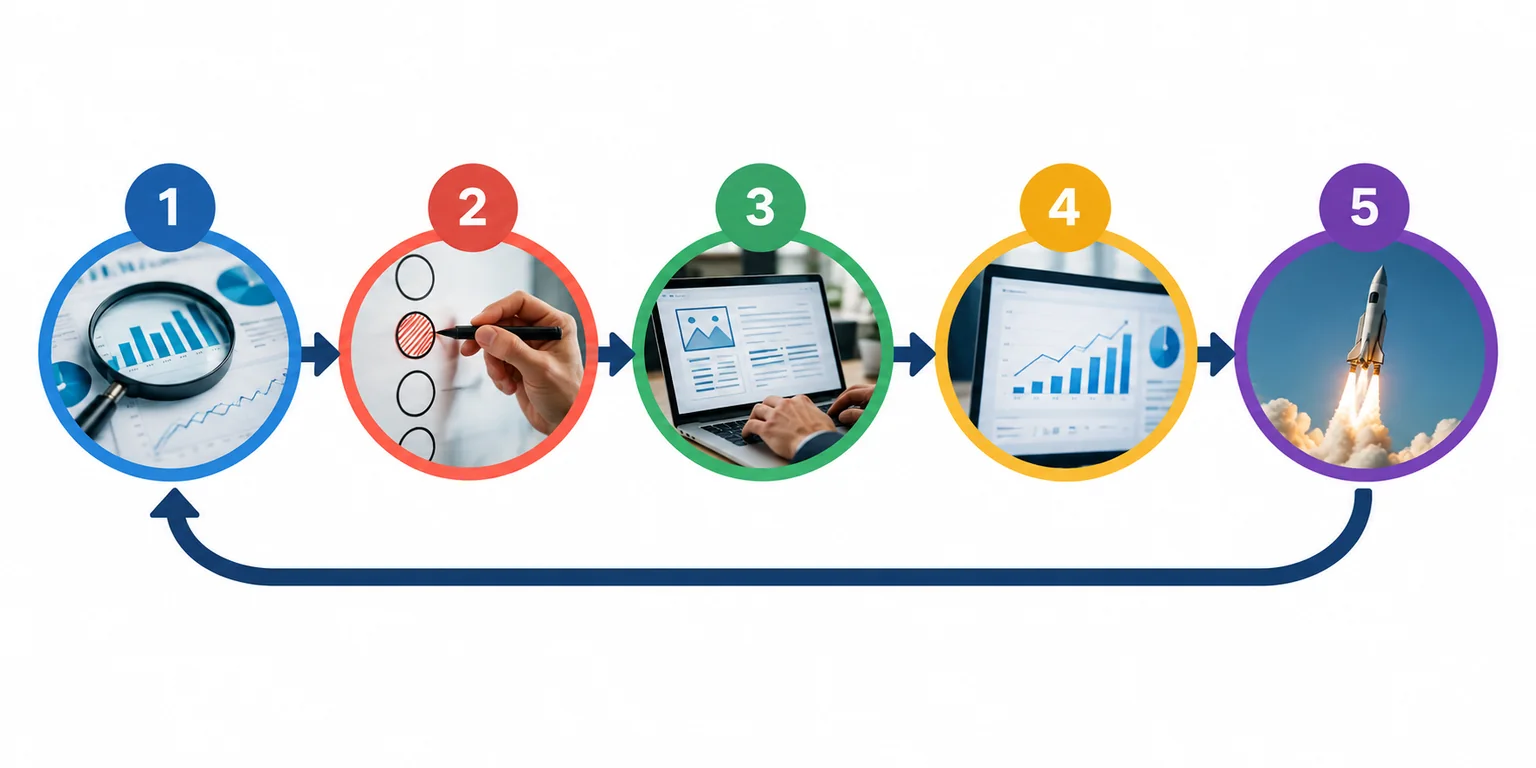
10. How will you measure results and change the work based on what you learn?
A monthly report should help you make decisions. What is working? What is attracting contacts who are not a fit? What should we correct or stop doing?
Measurement may include visibility in relevant searches, visits to commercial pages, qualified enquiries and opportunities recorded by sales. Where the data allows, it should also connect to revenue. The consultant must explain the limitations of that connection, particularly in long sales processes with multiple touchpoints.
What to ask for: agreed indicators, a review frequency and an example of how a finding would change an action. If many enquiries come from people without a budget or a suitable need, increasing their number does not solve the problem.
In my work, I call this cycle MAPELI: measure, analyse, prioritise, execute, learn and improve. To make it useful, I bring together marketing data, sales information, product knowledge and signals from competitors. We review priorities in two-week cycles; that does not mean all results appear within two weeks.
Warning sign: they deliver the same report every time and continue the same actions regardless of what happens.
Before signing, ask for a proposal that answers these questions
You do not need ten perfect answers or a consultant who claims to know everything. You need to understand whether they know how you sell, have relevant experience, can demonstrate their work and make clear who will deliver it.
Ask the proposal to set out the commercial objective, initial priorities, responsibilities, cost and how progress will be evaluated. If something is not yet known, it should say so and explain how it will be investigated.
The question that ties the whole article together remains the same: how will this work help your sales team sell better?
Would you like to review whether your marketing is helping sales?
We can start with a conversation about your business, your markets and how opportunities reach you today. From there, we can see what is worth analysing and what the first improvements might be.
Explore my approach to B2B sales and marketing, review examples of results or tell me what your company needs.
To go deeper, read how the JS Growth Engine sets priorities from data, how B2B demand generation supports sales, and what marketing outsourcing looks like in practice.