1. Starting point
Construction is one of the slowest-digitalising industries in the world.
It is almost impossible for a large construction company to buy software directly from an unknown Finnish SaaS vendor. Having a good product isn’t enough.
The biggest obstacle isn’t the product. It’s trust.
2. Challenge
The traditional answer would have been to hire salespeople in every target country or to buy sales outsourcing from a classic partner offering an external sales team.
Both options are slow, expensive and risky. They mean fixed costs in every country long before the first contract is signed.
An SME often can’t carry that financial burden — and it shouldn’t have to.
We wanted a model where sales costs would appear only when sales actually happen.
3. Strategy
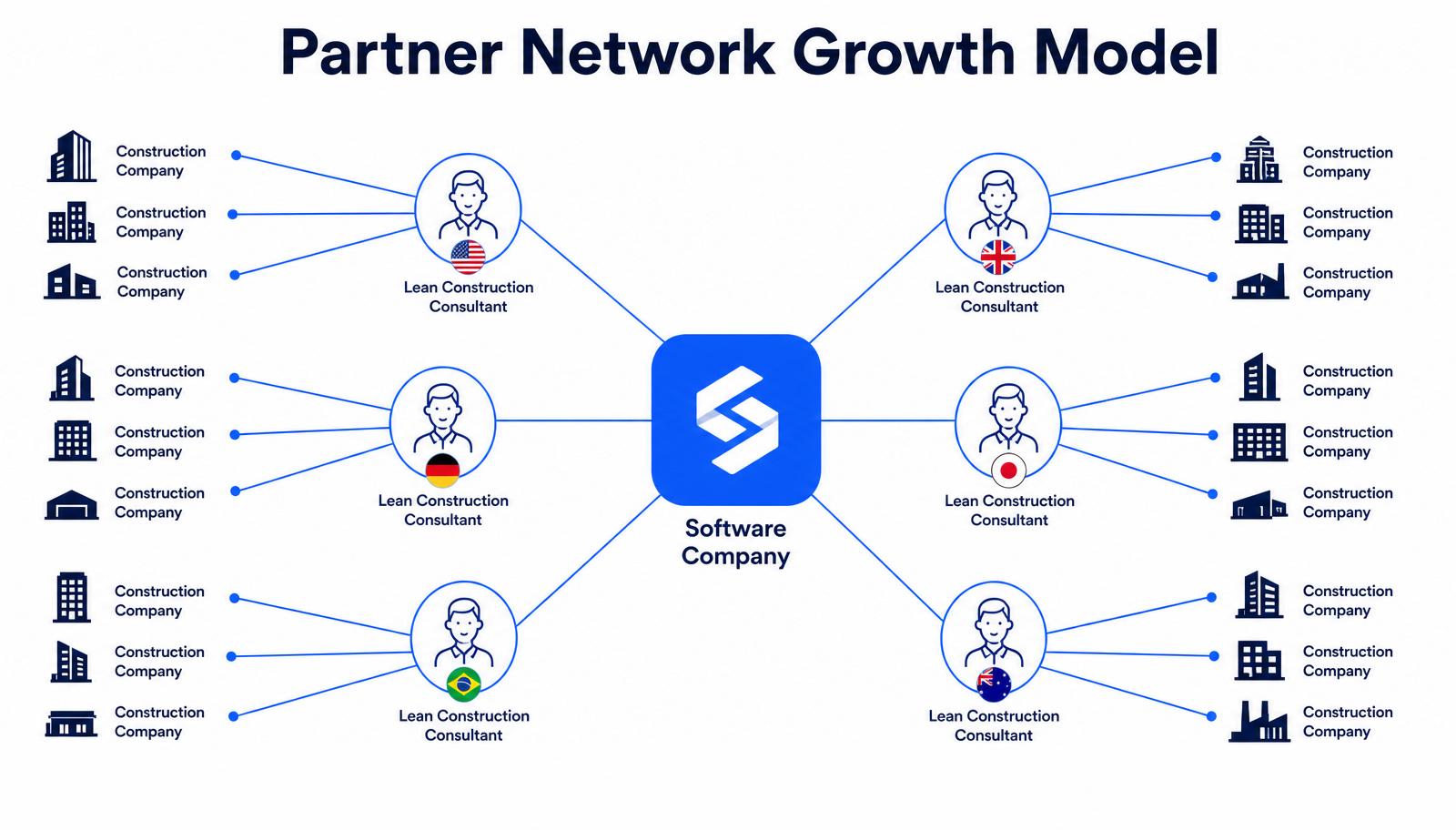
We noticed that the construction industry has its own layer of experts: Lean Construction consultants.
Their job is to make construction more efficient, speed up projects and help firms change how they operate. When one of these consultants recommends a piece of software to a client, the trust is already there.
So we didn’t try to sell the software directly to construction companies. We built a partner model.
The goal wasn’t to find customers. The goal was to find companies and people who already had the customers’ trust — and to make them part of an international sales network.
4. What was actually done
We built a clear partner programme: what the partner gets, what they’re expected to do and how the collaboration is measured. The goal was a programme attractive enough for an international consultant to say yes without a long negotiation.
We built a dedicated landing page for the partner programme, aimed entirely at Lean Construction consultants — not at construction company executives. The page answered one question: why would you, as a consultant, benefit from this programme.
Automated outreach delivered roughly 10 personal contacts a day to the right consultants across countries. Not mass mailing, but systematic and targeted communication — day after day.
We built an expert community for the partners, where they could share experiences, discuss practices and network with each other. The community wasn’t a sales channel — it was the reason to belong to the network.
A regular newsletter and continuous partner activation kept the software present in the consultants’ daily work. When a consultant met a client with the right problem, the software was the first thing on their mind.
5. Results
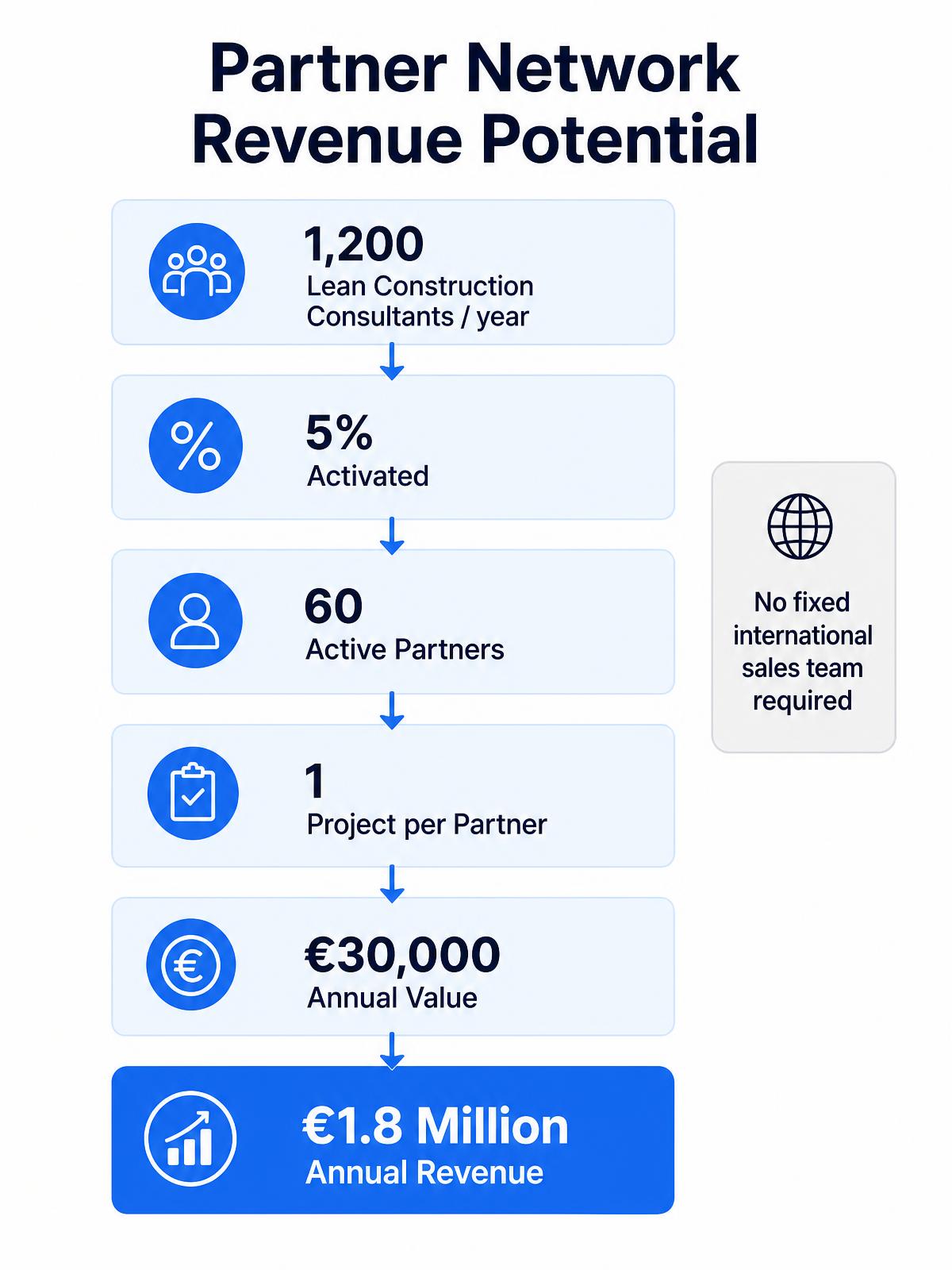
What if only 5% of partners activate?
- 11,200 partners per year
- 25% activate
- 360 active partners
- 41 project per partner
- 5€30,000 annual value
- 6€1,800,000 in new annual revenue
This is based on a very conservative assumption: only 5% activate and each partner sells just one project per year. The real potential can be considerably higher.
More than a hundred consultants joined the Lean Construction Expert Community very quickly. Alongside that, we built a model that could add roughly 1,200 new partners a year.
In practice, the partners became an international sales network. Every new partner could recommend the software to their own clients — in countries where a full sales organisation would never have been feasible.
The headline wasn’t the number, though. The most important thing was that every partner brought pre-existing trust with their own client. That is something a traditional sales organisation can’t buy — at any price.
6. What I learned from this project
This is a project after which I look at the phrase "sales outsourcing" very differently than before.
Most people think sales outsourcing means an external sales team. A person or team that calls customers on the software company's behalf and gets paid for closed deals.
In this case, sales were outsourced to a very different kind of party: an expert network. The partners didn't make cold calls. They did sales work as part of their existing client relationship — at the moment the client had a real problem to solve.
The software company didn't have to build its own international sales organisation in every country. Every active partner effectively replaced a chunk of the work a local salesperson would have done — without the fixed cost.
In my view, one of the biggest mistakes in international B2B sales is trying to build your own sales organisation in every country. It's slow and expensive. In many industries it's not even possible.
Often a faster and much more scalable answer is to find the people who already have the customer's trust. When the partners succeed, the software company grows too.
A well-built partner network can be more effective than an organisation of dozens of your own salespeople — and at a much lower risk.
7. How to apply this in your own company
Could a partner network work for your company too?
If you’re considering international growth or looking for an alternative to traditional B2B sales outsourcing, start with three questions.
1. Who already has the trust of your ideal customers? Look for experts, consultants or integrators who already work with those same customers today — in a different role.
2. Do you have a clear promise for the partner? A partner won’t recommend your product out of goodwill. They need to see the benefit for their own business and their own client relationship.
3. Can you build the partners a community, not just a contract? A long-lasting partner network is built when partners also get value from each other — not only commissions.
Once those answers start to take shape, the next step is a strategy call. Let’s look together at what your own partner network could look like.