I have used AI every single day for years. Not occasionally. Not experimentally. Every day. I use it to build international marketing strategies, analyse data, automate reporting, optimise Google Ads, generate SEO insights and, increasingly, design AI agents that work together.
During the last year one observation has become impossible to ignore. The definition of marketing automation has fundamentally changed.
Table of contents
- The old definition of marketing automation
- The real shift
- From workflows to orchestration
- This is exactly what I am building
- Existing platforms are not disappearing
- Why this matters
- My prediction
- Conclusion
The old definition of marketing automation
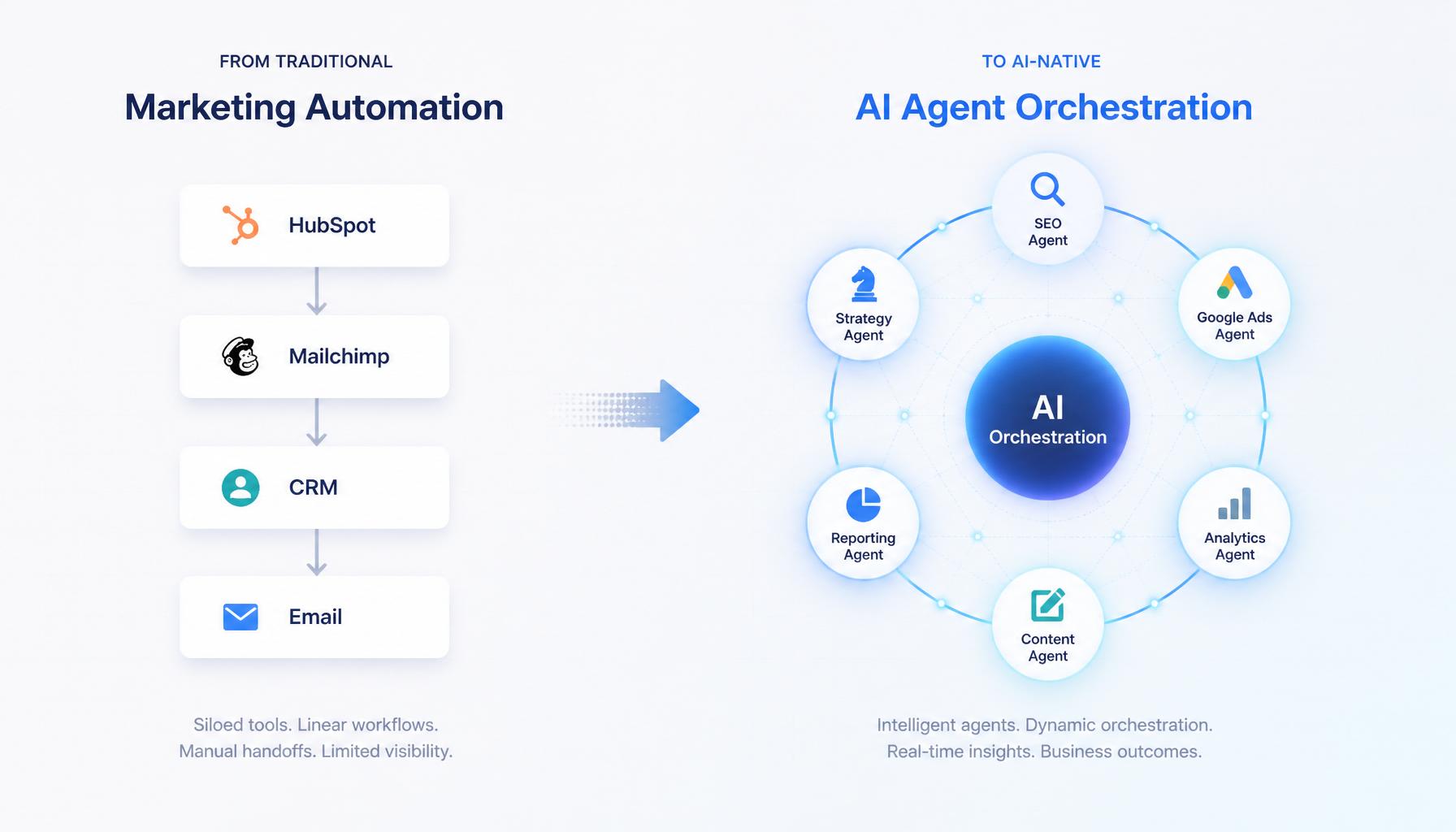
For many companies marketing automation still means the same thing it meant ten years ago:
- HubSpot
- Mailchimp
- ActiveCampaign
- Marketo
These platforms helped companies automate repetitive tasks: email campaigns, lead nurturing, lead scoring, CRM workflows and internal notifications. For years that represented modern marketing. Today I believe that definition is becoming outdated.
The real shift
The biggest change is not another AI feature bolted onto existing software. The biggest change is that automation is moving away from individual software platforms. In its place a new ecosystem of specialised AI agents is emerging.
From workflows to orchestration
Traditional marketing automation followed predefined workflows. If X happens, do Y. It worked, but it was rigid — every rule had to be defined by a human in advance.
AI works differently. Instead of one workflow, multiple specialised agents collaborate. For example:
- one agent analyses Google Ads
- another analyses Search Console
- another analyses CRM data
- another writes executive summaries
- another prioritises next actions
- another prepares content
- another evaluates performance
None of these agents replace the others. Together they become an intelligent marketing team. That is orchestration.
This is exactly what I am building
Much of my current work no longer involves building campaigns. Instead I spend my time designing systems where AI agents perform specialised tasks together.
The objective is simple. Humans spend their time making strategic decisions. AI performs the repetitive analysis, reporting and execution. This is fundamentally different from automating email sequences. It is not about building rules — it is about building a system that continuously learns.
Existing platforms are not disappearing
This is an important distinction. I do not believe platforms like HubSpot or Mailchimp will disappear. In fact, they will probably become significantly better. But their role will change.
Instead of being the centre of marketing automation, they will become one component inside a much larger AI ecosystem. The intelligence moves away from the platform itself. The intelligence moves into the network of AI agents.
Why this matters
Companies that continue thinking about marketing automation only as CRM workflows may still improve efficiency. But companies that learn to orchestrate AI agents will gain an entirely different competitive advantage.
- Instead of automating one task, they automate decision making.
- Instead of creating reports, they create systems that continuously analyse, recommend and improve.
- Instead of running individual campaigns, they build a marketing engine that improves itself in real time.
This is directly connected to how B2B SEO and AI-driven search now work together and to how a real demand-generation ecosystem is built. Instead of optimising one platform, you optimise an entire intelligent system.
My prediction
Over the next five years one question will become increasingly important. Not this:
But this:
That will become the real competitive advantage.
Conclusion
I no longer think about marketing automation as software. I think about it as an intelligent organisation made up of specialised AI agents. For me that is what modern marketing automation has become. And I believe we are only at the beginning.
If you lead a B2B company and you are thinking about how to scale international growth or how to structure a long-term growth system, the honest question to ask is: are we still building workflows, or are we already building orchestration?
Related reading: